Plug in your numbers.
See the answer now.
A simplified version of the math inside the app. For the full period-by-period schedule, rate changes and tiers, use the app.
Shorten term keeps the payment and ends the loan sooner, which usually saves the most interest. In the app you can switch to Lower payment and compare the two.
Equal payments, fixed rate, example figures only. Your lender's numbers may differ.
See the full schedule in the app →Going interest-only?
See the cost first.
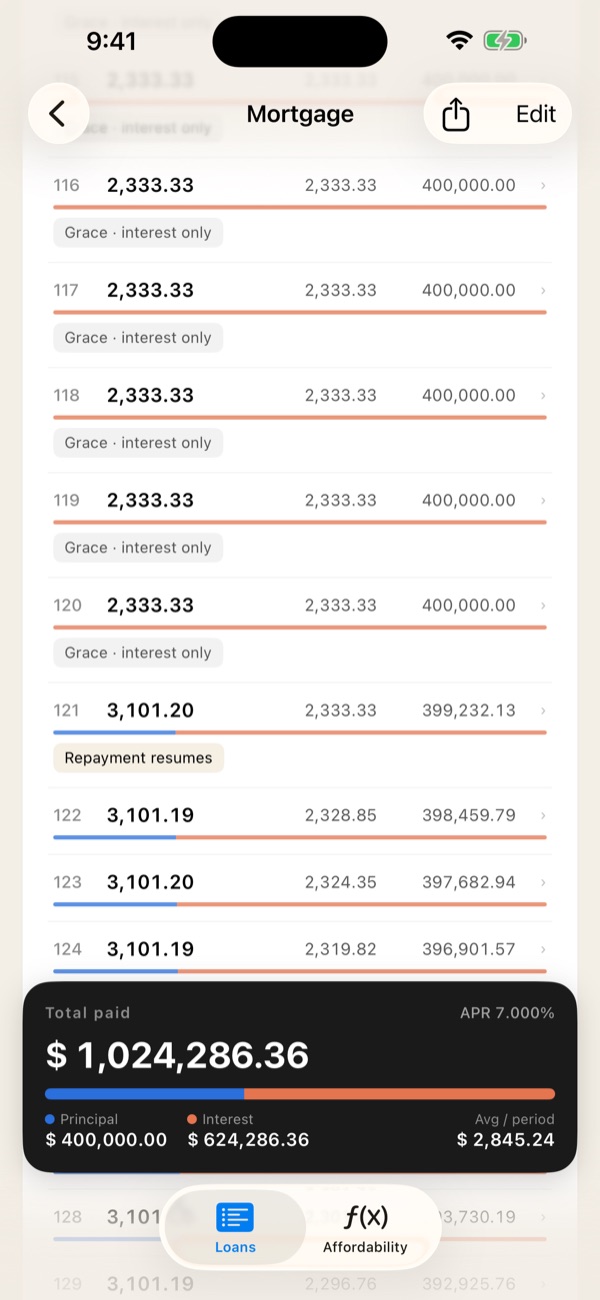
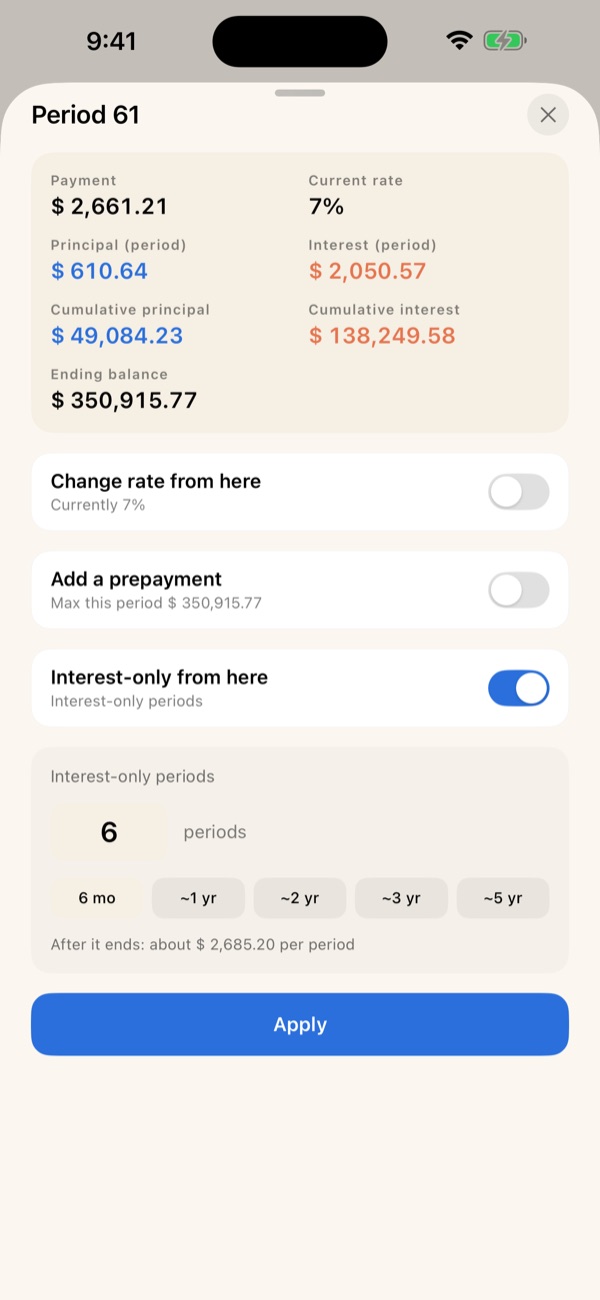
Tap any period in the schedule and turn on “Interest-only from here”. Before you apply it, the app shows what each payment will be once the stretch ends.
- Type an opening interest-only period, or tap 6 months, 1, 2, 3 or 5 years
- Add several stretches to one loan; stretches that touch or overlap are merged
- The end date stays put, and you get a warning if the principal would fall due as one large final payment
- Extra payments still work during an interest-only stretch
Pay $25,000 extra.
How much sooner are you done?
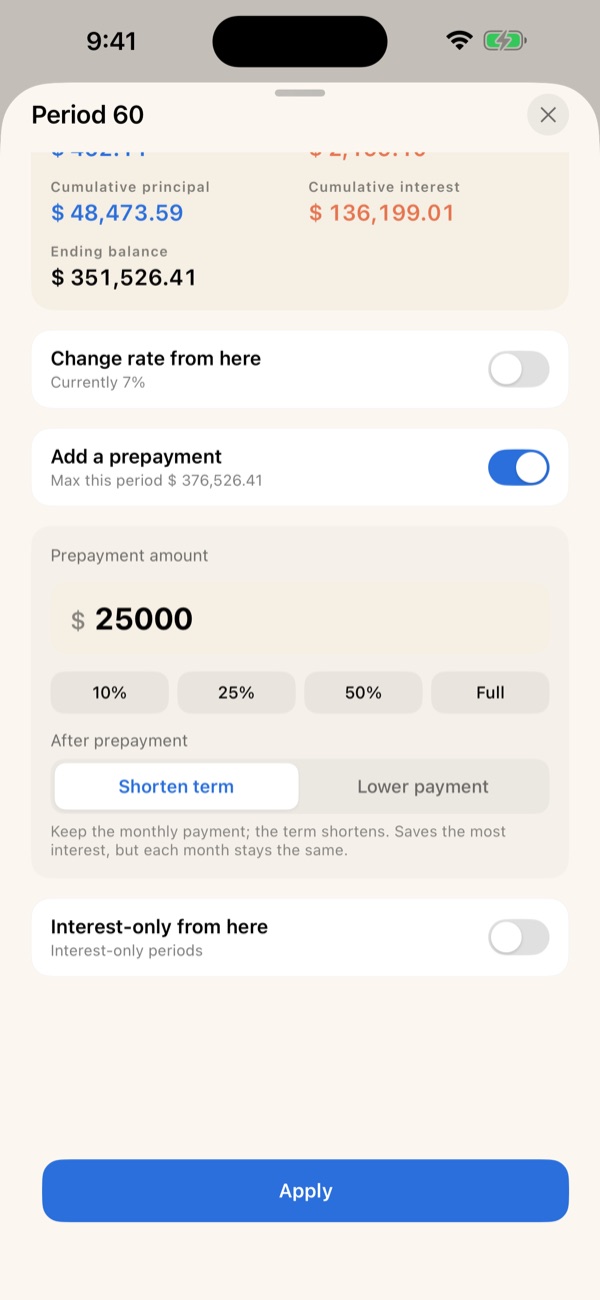
Add a lump sum at any period and choose Shorten term or Lower payment. The total interest and the payoff date update straight away.
- Shorten term: same payment, finished sooner, usually the biggest saving
- Lower payment: same end date, a smaller payment every month
- Any unpaid interest is cleared first, then the principal falls
Rates go up half a point.
What happens to the schedule?
Change the rate from any period onward and the schedule recalculates. Promotional deals, with a lower rate for the first years and a standard rate after, can be set up as rate tiers.
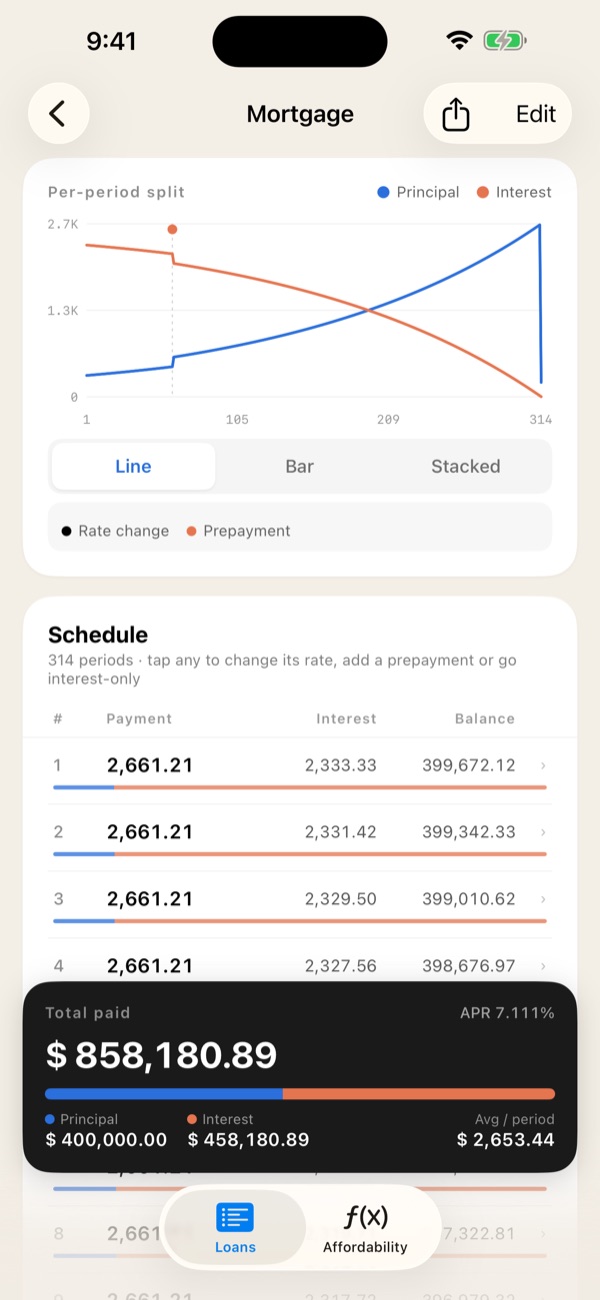
- Line, bar and stacked charts of principal and interest
- Interest-only stretches are shaded, and rate changes and extra payments are marked
Every offer,
side by side.
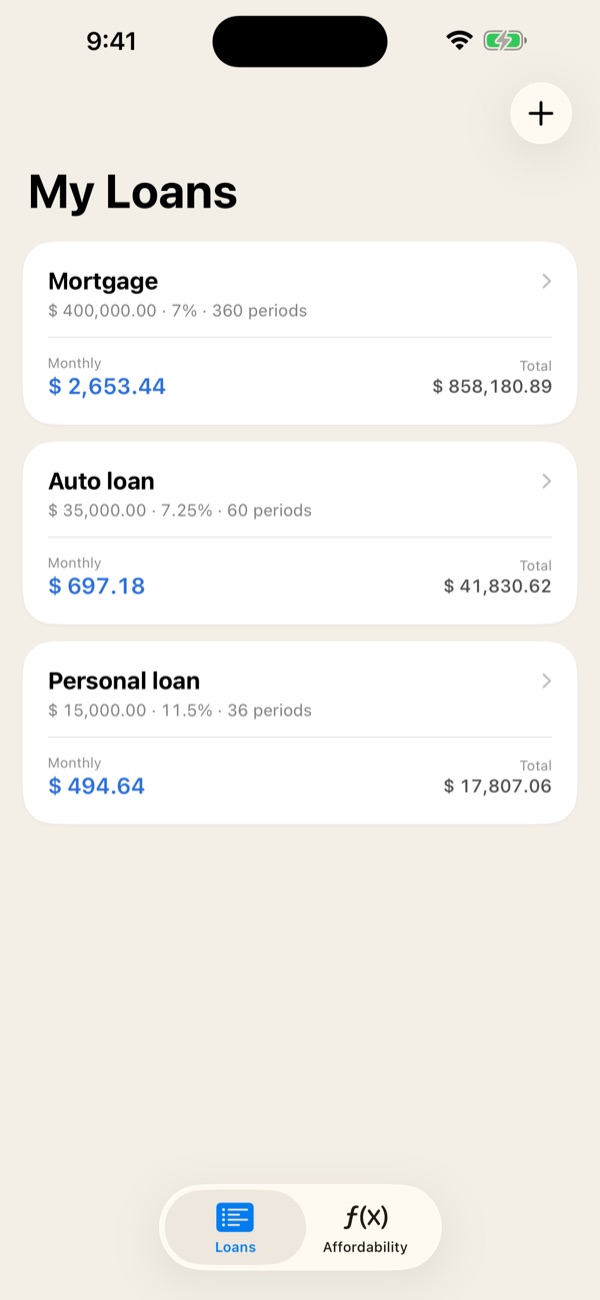
Every loan's monthly payment and total cost at a glance. Refinancing or choosing between lenders? Save each offer and compare them side by side.
- The fee-inclusive APR shows what each offer really costs
- Set a first payment date to see what is left from today
Small tools, done properly.
True APR with fees
Add origination or processing fees; the effective APR is computed with an IRR.
Affordability
Start from a monthly budget and find how much you can borrow, or how long payoff takes.
Export and share
CSV and PDF schedules, or a summary image to send to family.
10 currencies
USD, EUR, GBP, AUD, JPY and more, defaulting to your device's region.
Japan's 5-year and 125% rules
For Japanese variable-rate loans, with unpaid interest tracked in the schedule.
Dark mode, 4 languages
English, Traditional Chinese (Taiwan and Hong Kong) and Japanese.
Your loan stays
on your phone.
No sign-up, no login. Every calculation runs on your device, and the numbers you enter are never uploaded.
The app is free and shows a banner ad. See the privacy policy.
- 🔒 No account needed
- ✈️ Works in airplane mode
- 📵 No contacts, photos or location permission
Everything it does, in one table
| Price | Free (banner ad, no in-app purchases) |
|---|---|
| Platforms | iPhone and iPad (iOS 16 or later), Android (7.0 or later) |
| Repayment | Equal payment (annuity) or equal principal |
| Interest-only | An opening period, plus stretches from any period; several per loan, merged when they touch; the end date stays and the payment is recomputed |
| Rates | Rate change from any period; rate tiers (promotional, then standard) |
| Extra payments | Shorten the term or lower the payment; unpaid interest is cleared first |
| Fees and APR | One-off fees and the fee-inclusive APR (IRR) |
| Also | Affordability, first payment date, Japan's 5-year and 125% rules, line, bar and stacked charts |
| Export | CSV and PDF schedules, summary image |
| Currencies | USD, EUR, GBP, AUD, SGD, JPY, TWD, HKD, CNY, KRW (default follows your device region) |
| Languages | English, Traditional Chinese (Taiwan), Traditional Chinese (Hong Kong), Japanese |
| Privacy | Offline, no account, loans never uploaded |
| Latest version | 1.1.1 (September 2026) |
The payment after interest-only, worked out
A level (equal) payment is payment = P × r ÷ (1 − (1 + r)−n), where P is the balance, r the monthly rate (annual rate ÷ 12) and n the number of payments.
While interest-only, payment = P × r and the balance does not fall. When the stretch ends the maturity date stays the same, so the payment is recomputed over the periods that are left: n is the total number of periods minus the interest-only ones.
Example: $400,000 at an example rate of 7% over 30 years (360 payments), with the first 10 years (120 payments) interest-only. During those years you pay $400,000 × 0.5833% = $2,333.33 a month. Afterwards the loan is recomputed over the remaining 240 payments: $3,101.20 a month, 33% more. With no interest-only period the payment would be $2,661.21 throughout, and the interest-only version costs about $66,251 more in total interest.
Assumes a fixed rate and no rounding adjustments. Your lender's day count and rounding may differ; rely on the figures your lender gives you.
Questions before you borrow
What happens to my payment after an interest-only period?
In LoanCalc the maturity date stays the same, so the whole principal has to be repaid in fewer periods. The payment after the interest-only stretch is recomputed from the remaining balance, the rate at that time and the number of periods left, which makes it higher than a loan without the stretch. Total interest also rises, because the balance stayed high for longer. Some lenders extend the term instead, and whether you can go interest-only at all, and on what terms, varies by lender and country.
Should an extra payment shorten the term or lower the payment?
Shortening the term keeps your payment the same and usually saves the most interest. Lowering the payment keeps the end date and reduces each later installment, which eases your monthly budget. LoanCalc lets you try both on the same loan and compare the total interest and the payoff date. If unpaid interest has built up, an extra payment clears that first and then reduces the principal.
Why is the APR higher than my interest rate?
The nominal rate ignores one-off fees. The effective APR spreads those fees over the life of the loan by solving for the rate at which the money you receive equals the payments you make (an IRR). Two offers with the same rate can have different APRs if their fees differ.
What are Japan's 5-year rule and 125% rule?
Some Japanese banks review the payment on a variable-rate, equal-payment mortgage only once every five years (the 5-year rule), and at each review limit the increase to 25% (the 125% rule). If rates rise far enough, the fixed payment may not cover the month's interest, and the shortfall is carried as unpaid interest. LoanCalc can simulate this. Details differ between banks and contracts.
Is LoanCalc a lender? Are the results exact?
No. LoanCalc does not lend money, collect payments or ask for personal data. It is a planning tool, and its figures are estimates that may differ from your lender's official statement because of rounding, day counts and contract terms.
Run the numbers
before you sign.
Free, offline, no account. iOS 16 or later, Android 7.0 or later.